Click to login
Francis Shanahan[.com]
My Book Reviews
[May 16/08, 6:48 AM]
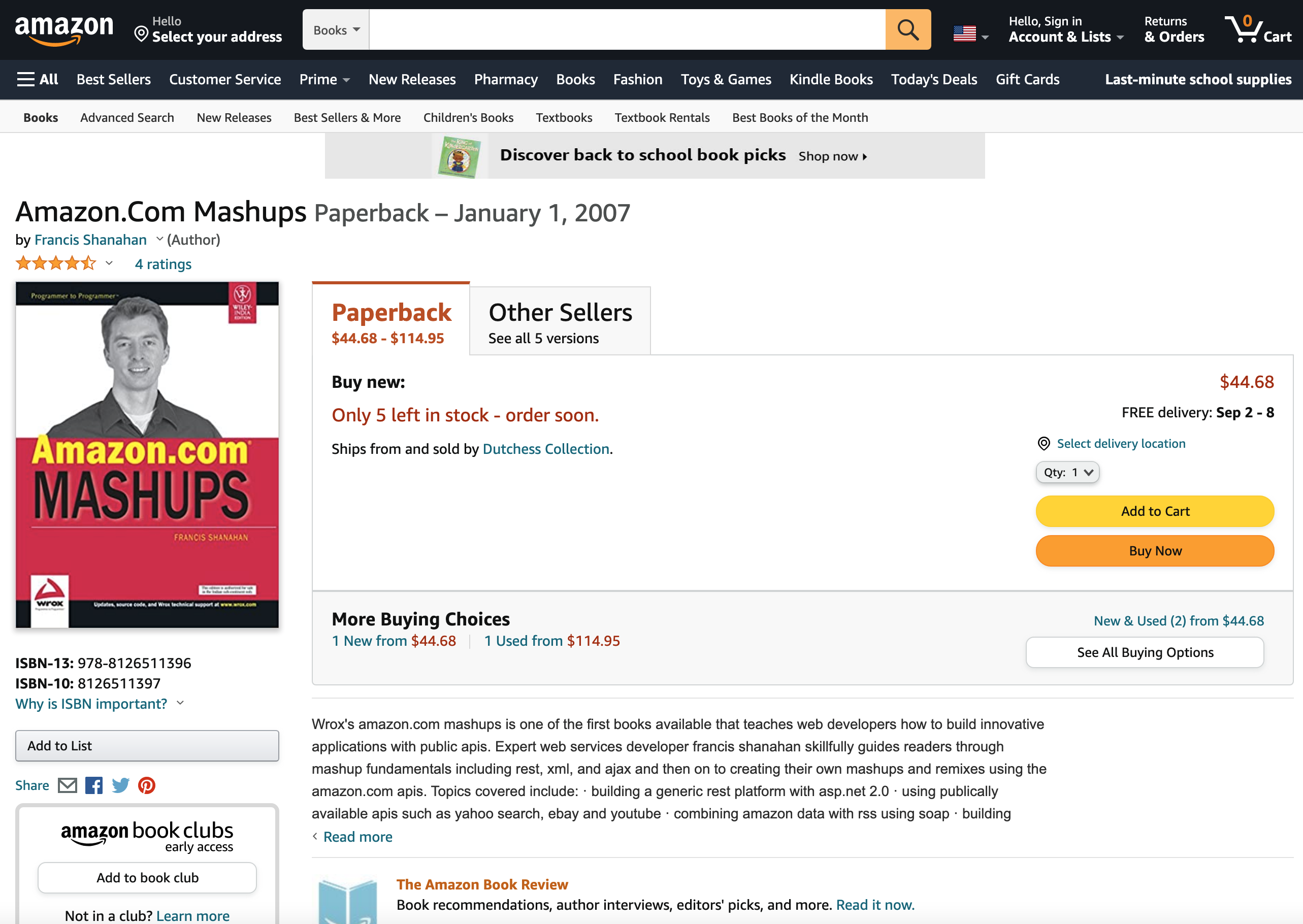
My book's been for sale over a year now. It was written back in 2006 and released in 2007. I fully expected the whole "Mashup" craze to be over and done with at this point. Here we are in 2008 and I'm still hearing folks touting this as "cutting edge". The latest evidence came this week actually when a vendor presented their "web 2.0" capability as if we'd never heard of it.

Writing a book is fairly rewarding. Just the satisfaction of seeing the words you've toiled over printed and bound is a unique experience.

Probably the most rewarding thing though is to read the reviews. The book is published in a number of countries. I will now shamelessly include two reviews. One from the US and one from the UK.

Robert Robbins, (Williamsport, PA USA) - "The book covers more than the Amazon APIs so I recommend it if you are interested in mashups in general. I'm very keen on JSON right now and was pleased to find that covered as well. I think the author is a very good programmer who has many clever ideas like using XSL to transform XML into JSON (although using Yahoo! Pipes is easier). I'd have to say that this is one of the few programming books I've read that presented some really ingenious solutions and creative project ideas. Most books just provide uninspiring "Hello World" examples." [LINK]

Alix, (South East) - "Recently purchased this title, and it is quite excellent. From the outset the author makes you aware that this is not going to be another of those boring manuals. He is true to his word, it is crammed with information that you will need to become familiar with if you are looking to write new web applications that havent been done before. There is plenty of information for those in the earlier stages of learning all things ASP.NET and then you are smoothly introduced into the requirements for creating mashups and remixes of widely available APIs. The real strength of the book is in inspiring your imagination to come up with new web based applications, summed up by the fact that i wanted to read and finish this book as quickly as possible because you know that good stuff is waiting for you in the later chapters." [LINK]

I'd say I'm happy with that.
TrackBack URL | Add Comment.
Filed under: My Book
Logical Fallacies in Software Architecture
[May 14/08, 6:59 AM]
I've been trying to improve my critical thinking abilities of late and to that end, the Skeptic's Guide the Universe [LINK] has been very helpful. It's through this means I've been re-exposed to the notion of the "logical fallacy". Here's a link if you're not familiar with the concept [LINK].

"A logical fallacy is a false or incorrect logical principle. An argument that is based upon a logical fallacy is therefore not valid."

Example A=B and B=C therefore A=C.

A logical fallacy might be A=C and B=D therefore A=B.

There's essentially no basis for this A=B assertion. This is a trivial example and easily pointed out. When you get into things more complex items reflecting items in the real-world it gets harder.

Here are some Logical Fallacies I'm seeing in software design:

1) Argument from authority: Stating that a claim is true because a person or group of perceived authority says it is true. E.g. "this thing scales, the vendor said so".

2) Looks Good on Paper: A particular design looks elegant and can be easily explained on paper. However is non-performant and entirely unmaintainable in real-life. Example of this is the "enterprise service bus".

3) Design from Best of Breed: Identify the functional areas covered by your architecture, then pick best of breed in each area. You end up with a master of all trades, Jack of none. Your system needs to hang together, you can't take each area in isolation.  These days with software acquisitions you can't even be guaranteed that choices from a single vendor will hang together as they might have been developed by different smaller companies.

I probably have a few more if I were to think about it. These sort of build on an earlier post "Vegetable Design Patterns" [LINK].

More on this later...

TrackBack URL | Add Comment.
Unfiled
The Quackometer on Homeopathic Medicine
[May 9/08, 6:44 AM]
A terrific article on the "Quackometer" here [LINK]. It talks about the lack of clinical testing and scientific evidence to backup the incredible claims made by the alternative medicine community.

Why do I care about this? Actually normally I wouldn't care. Just that Karen has cancer.

When a loved one is ill, you'll do anything to improve the situation. When Karen was diagnosed (over a year ago), I quickly set about researching her form of cancer, trying to uncover a potential cure or complimentary therapy.

I quickly became overwhelmed with information. Let me give you the rundown of *crap* I uncovered as potential cancer cures:
  • Reishi Mushrooms
  • Reiki (laying on of hands)
  • Flax seed + Cottage Cheese
  • Fish Oils
  • Essiac Tea
  • Green Tea
  • Pomegranate
  • Turmeric
  • Feng Shui
  • Homeopathy
  • Fresh Cell Therapy
  • Naturopathy
  • Immuno-augmentative therapy
  • Shark Cartilage
Now let me tell you what I've discovered...IT'S...ALL...B*LLSH1T!!!

That's right. Bullshit. There is no clinical peer-reviewed evidence of the efficacy of any of this *crap*.

There are two types of people preying on the cancer community: BS artists and Con artists. The first are ignorant morons, the latter are insidious opportunists.

I have every reason in the world to want this stuff to work. So does just about every cancer patient or caregiver. That makes us easy targets.

Not only do they prey on the victim's finances, more importantly they offer false hope to a group of people who are already at their most vulnerable. To which hope is needed most.

If these therapies had even a PERCENTAGE of the efficacy they claim, it would make sense then that every cancer treatment regime would factor them in. The response to this typically is that the pharma industry actively dis-credits these alternative medicines in an effort to push their drugs. Sorry, that's just plain false.  As Mark Twain said (paraphrasing) "A lie will journey around the world before the truth has put on its shoes".

Lastly and most deplorable, each of these therapies has its own chemistry. By introducing additional moving parts into the mix you run the risk of lessening the effect of clinically proven therapies.

I liked the following quote which was actually focused on prayer as a therapy (not the focus of this posting).
This pithy quote came from a cancer patient:

"Jesus is great but don't try Jesus without Chemo".
TrackBack URL | Add Comment.
Filed under: Life
The Dangers of Belief
[Apr 28/08, 6:41 AM]
I've written in the past on how we as humans are hard-wired to "believe", that is accept things without question. There have been volumes written on the inherent tendency we have to "trick" ourselves. I'm sure there are evolutionary advantages to this in some ways but that's not the focus of this post.

This post is about the tangible dangers of unquestioning belief + group dynamics. Two recent articles highlight what I'm talking about:

  • a)'Penis Thefts' Cause Panic In The Congo [LINK]
    • "Congolese police have arrested 13 suspected sorcerers accused of stealing men's penises after a wave of panic and attempted lynchings triggered by reports of the witchcraft."
  • b) Thieves cut off holy man's 'magic' leg [LINK]
    • "Police are hunting two men who attacked a holy man and chopped off his right leg. The men apparently believed the leg had magical powers. The holy man, Yanadi Kondaiah, 80, claimed that those who touched his leg would be cured of illness or have wishes granted."
The first story speaks for itself. Somehow there's a market for severed penises. Great.

The second I heard about on the Skeptic's Guide the Universe [LINK] and is even more bizarre. First if the leg was indeed magic, why didn't the holy man just wish the attackers away? Or why didn't he just cop to it in the midst of the attack and say "listen, I was just kidding, my leg's not really magic". And how stupid were the attackers? Was the plan to just take the leg, then open up shop elsewhere with a severed rotting appendage? Once they got back to their hideout, how long before they realized "hey, this leg is stinking, can we wish away the smell?".

These are extreme examples but it just goes to show the lengths believers will go to. And guess what...YOU're a believer too. There are things which you hold as truths. They might not be magic legs but there are things. Just because they're more mainstream beliefs, doesn't make them accurate. Remember up until a few hundred years ago folks thought the Earth was flat [1].

So you must ALWAYS question and in my instance, I've even forgotten WHAT to question. Beliefs become so ingrained that they subtly become fact.  Case in point; The example I JUST gave of a Flat Earth....is actually a Myth [LINK].
TrackBack URL | Add Comment.
Filed under: Life
The Evolution of Problems
[Apr 25/08, 6:05 AM]
The key to success...in life...is... problems.

First there is just you.

Someone will hand you a problem, and ask for a solution. You'll give them the answer when it's fait accomplis. How long it took is how long it'd take.

Time passes, you grow smarter. Estimation develops. When someone hands you a problem, you know ahead of time how long it'll take.

Soon you're fixing problems predictably.

Then the problems get bigger. The problems themselves contain problems. When you encounter an unexpected problem, you can fix that too.

Before long you don't need someone to hand you the problems. You start finding them yourself. Of course these get thrown over the wall because you're the "problem finder", not the "problem solver".

Folks appreciate this and it's fun. Before long you can spot a problem a mile away. Folks come to you for advise, as if you are some kind of "Problem Oracle at Delphi".

It's a comfortable place to be. No responsibility. No hard problems to solve. Adoration from the needy.

This is where MOST people get stuck.

Next time you're wondering why your career is stuck ask yourself these basic questions:
"What types of problems am I working on?"
"Do people HAND me problems? Or do I seek them out?"
"Why don't people give me BIGGER problems?"
"Am I a Problem FINDER? or a Problem Solver?"
"When I escalate, do I share Problems with others? or do I share SOLUTIONS?"
"How can I share a BIGGER solution? (answer: find a bigger problem)"

This might seem like a BS "The Secret" type posting but there's a grain of truth to it.

TrackBack URL | Add Comment.
Filed under: Life
OSIS Interop Media Alert
[Apr 10/08, 6:27 AM]
I'm a bit late with this one....Shamelessly copied from Axel's blog [LINK]

-==============================-
FOR IMMEDIATE RELEASE

April 7, 2008

MEDIA ALERT
Showcasing How Users Can Control their Identity Online, Industry's Largest Identity Interoperability Demonstration Scheduled for RSA 2008
Fifty-seven member open source identity group to test and demonstrate interoperability between user-centric identity protocols and providers

SAN FRANCISCO (RSA Conference 2008) - April 7, 2008 - Open Source Identity Systems (OSIS) will conduct the largest user-centric identity interoperability test and demonstration at the 2008 RSA Conference, April 7-11 at the Moscone Center in San Francisco. The 33 member organizations and 24 projects of OSIS will showcase network interoperability between identity providers, card selectors, browsers and Web sites, demonstrating practical uses for user-centric identity technology, including how users can "click-in" to Web sites via self-issued and managed Information Cards and OpenIDs. The user-centric identity model gives consumers greater control and security over their identity information, allowing them to determine how sensitive identity information should be shared at each visited Web site.

During the demonstration, OSIS members will illustrate interoperability between Information Card and OpenID software, the technologies behind user-centric identity.Features being demonstrated include:

* Enabling people to control what identity information is disclosed about them
* Portability of digital identities across software and platforms
* Management and use of Information Cards and OpenIDs
* Information Cards used with OpenIDs to enable phishing-resistant sign-in to Web sites

WHO:OSIS, a working group of Identity Commons (please see below for a list of companies and projects). Members of the group are committed to a goal of Internet identity interoperability across projects, protocols, companies and platforms.

WHAT:OSIS User-Centric Identity Interoperability Demonstration at RSA 2008

WHERE: RSA Conference, Moscone Center South, San Francisco, Mezzanine Level, Purple Room 220

WHEN:Tuesday, April 8 and Wednesday, April 9; public working sessions 11 am to 4 pm, demonstrations 4 pm to 6 pm
About OSIS

Open Source Identity Systems, a working group of Identity Commons, brings together many identity-related open-source and commercial projects, and synchronizes and harmonizes the construction of an interoperable identity layer for the Internet from open-source parts and software that interoperates with them. For more information on OSIS, visit http://wiki.idcommons.net/index.php/OsisCharter.
OSIS participating companies:

* AOL
* ATE Software
* CA
* Cordance
* Fraunhofer FOKUS
* FuGen Solutions
* Fun Communications
* Google
* IBM
* JanRain
* LinkSafe
* Microsoft
* NetMesh
* Novell
* Nulli Secundus
* ooTao
* Oracle
* Orange
* Parity
* Ping Identity
* Plaxo
* Siemens
* SixApart
* Sun Microsystems
* Sxip Identity
* Thinktecture
* ThoughtWorks
* TrustBearer Labs
* VeriSign
* Vidoop
* WSO2
* Yahoo!
* Zend

Projects and Organizations:

* Bandit Project
* Codeplex
* DiSO Project
* Dominck Baier
* Drupal
* Francis Shanahan
* Higgins Project
* I-names
* Identity Commons
* Information Cards
* LID
* OpenID
* OpenInfocard
* OpenSSO
* Open XRI
* Pamela Project
* Rob Richards
* Sharp STS
* SignOn.com
* SourceID
* Shibboleth
* Verisign Personal Identity Provider
* Xmldap
* Yadis

All company/project names and service marks may be trademarks or registered trademarks of their respective companies/organizations.
OSIS Participants Contact Information:

http://osis.idcommons.net/wiki/Category:Participant
Media Contact:

Charlotte Betterley

Novell

(781) 464-8253

cbetterley@novell.com
-==============================-
TrackBack URL | Add Comment.
Filed under: Digital Identity | Stuff I've Made
Logic and Stupidity
[Apr 9/08, 12:01 AM]
There's a great quote by Pierre Boutroux who said

"Logic is invincible because in order to combat logic it is necessary to use logic."

Makes sense right? Unfortunately there are a few corollaries to this.
  1. Logic can battled by Stupidity
  2. You cannot combat Stupidity with Logic.
  3. Only Stupidity can battle Stupidity.
Which brings me to another quote, this time I don't know the author:

"Never argue with a fool, they will lower you to their level and then beat you with experience."


TrackBack URL | Add Comment.
Filed under: Life
Are You A Good Skeptic?
[Apr 7/08, 11:39 PM]

"When a man finds a conclusion agreeable, he accepts it without argument, but when he finds it disagreeable, he will bring against it all the forces of logic and reason."  -Thucydides


Being a skeptic is hard. We are a breed of believers. Our brains are hard-wired to prohibit skepticism.


The world is over-populated with information. Our brains have to make sense of it ALL and over time have adapted to take "shortcuts" that prevent information overload. This makes it hard to exhibit good judgment.


Everything's an approximation. We don't truly see the world, rather our eyes collect information which is aggregated by the brain, then ENRICHED and converted into conscious thought. Same thing with hearing, touch, taste, all the physical senses.  The brain fills in the blank based on past experience or available information. You come away with an approximation of the actual event.


That's how illusions work (e.g. Persistence of Vision). That's how tricksters deceive us (e.g. misdirection).


This makes me wonder if the non-physical is an approximation too? Are we really feeling THAT sad, or do we just fill in the blank so that our overall mental state trends in a given direction? There's probably some truth to this; how often have you caught yourself being upset about something only to realize that it's not that big a deal? That's your brain, filling in the emotional blanks.


More often than not, we don't get to choose how each blank is filled in. To do so would quickly overwhelm our brain. The amazing thing is that our brain is multi-threaded. We can operate our limbs and move through the environment at the same time as focusing on the bird in the tree or the car on the road. We don't have to really focus to consciously realize that the bird's in the tree. Our brain fills in the blank. At the SAME time we can be consciously pondering what to eat for lunch.


And so this leads to the point of this post. Skepticism. When we're faced with a new experience and tasked with figuring it out, more often than not the unconscious mind forms its own conclusions without us even realizing. The non-skeptic will tend to use logic and reasoning to justify the unconscious minds' conclusion. In truth it should be the reverse. The conscious mind should follow a path of reasoning to arrive at a conclusion. That's skepticism.


I heard a good general guideline on the Skeptics' Guide to the Universe: focus on the process, rather than the conclusion. Ensure the thought process you're following is correct and whatever conclusions you arrive at are simply a side-effect rather than the objective.


"When intuition and logic agree, you are always right." - Blaise Pascal


TrackBack URL | Add Comment.
Unfiled
A Roll of the Eyes and a Smile
[Apr 7/08, 6:20 AM]
First the roll of the eyes: According the this CNET blogger, the RSA registration is vulnerable to SQL Injection! [LINK]

The Smile: This next is a bit self-serving but this latest review of my book [LINK] made me smile:

"The book covers more than the Amazon APIs so I recommend it if you are interested in mashups in general. I'm very keen on JSON right now and was pleased to find that covered as well. I think the author is a very good programmer who has many clever ideas like using XSL to transform XML into JSON (although using Yahoo! Pipes is easier). I'd have to say that this is one of the few programming books I've read that presented some really ingenious solutions and creative project ideas. Most books just provide uninspiring "Hello World" examples."
[LINK]

Pretty rewarding to get that kind of feedback.
TrackBack URL | Add Comment.
Unfiled
Identity Interoperability at RSA
[Apr 2/08, 6:32 AM]
Exciting times indeed in the world of Digital Identity. Huh? What the heck?

What's going on? The internet has a crappy way of managing your personal information. We're trying to fix that.

Why should I care? Right now you're at quite a high risk of having your identity stolen, losing control of your personal information, of being phished or losing track of what personal information is stored where. See my previous post on Identity Fragmentation [LINK].

So what are you talking about now? RSA is happening NEXT WEEK! (7-11th April) [LINK]

What's RSA? Only the largest conference focused on information security in the world. It starts in San Francisco and is replicated around the world.

Is Shanahan going to be there? Well no, but my code will be. A while back I created a Cardspace Identity Provider and Relying Party test harness [LINK]. That code has been participating in the OSIS Interop 2008.

What's OSIS Interop? It's a grass-roots effort to prove out the interoperability of various Identity solutions.

"OSIS User centric identity network interoperability between identity providers, card selectors, browsers and websites demonstrates how users can ‘click-in’ to sites via self-issued and managed information cards, or i-cards. Open ID, Higgins Identity Framework, Microsoft CardSpace, SAML, WSTrust, Kerberos and X.509 components interoperate within an identity layer from open-source parts."

We've been testing the interoperability (how things work together) of all these solutions since January. You can checkout the results of the testing here [LINK].

Who's participating?  Easy, just checkout this diagram (yes that's my logo underneath Bandit!): Click for a LARGER image.
Click for LARGER


Checkout what Mike Jones, Pamela Dingle and Kim Cameron have to say on the topic.

So get yourself to RSA and checkout the OSIS Interop room. They have BEER!!! [LINK]
TrackBack URL | Add Comment.
Filed under: CardSpace | Digital Identity | InfoCard | Stuff I've Made